
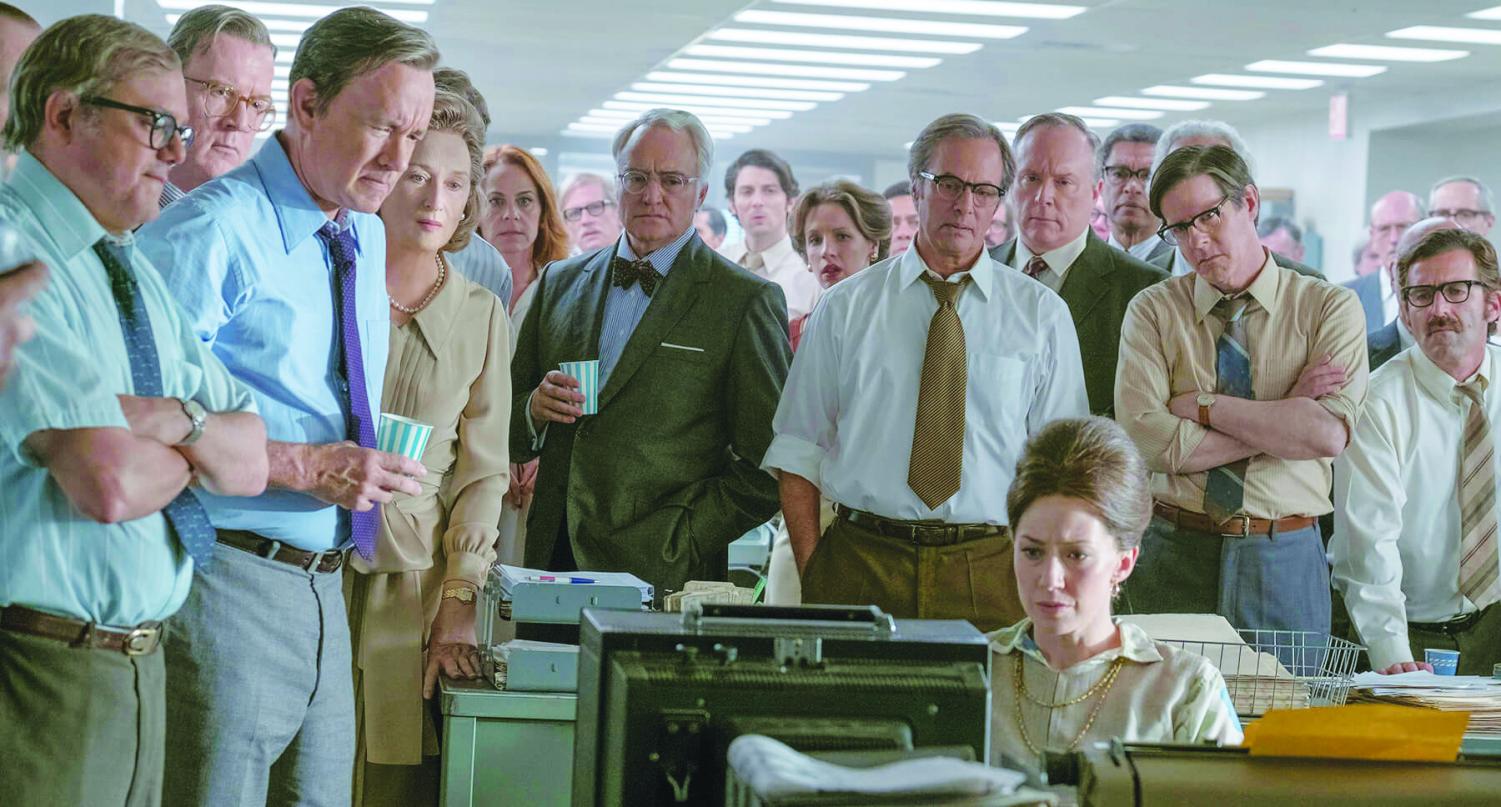
College journalists thoughts on seeing ‘The Post’
SuYoung Park, Justin Ngo, Marji Harris, Staff Writers
July 7, 2026
4.5 out of 5 stars
“The Post” is not movie with a lot of action, explosions or visual attractions to catch audience attention. However, even without the mind-blowing graphics, “The Post” is a captivating movie as it portrays real-life heroes who had a key impact on American politics and Vietnam-war-era history.
Meryl Streep plays Katherine Graham, owner and the publisher of the Washington Post who later started the new wave of the collective voice, giving media and public power when going up against government secrecy.
Seeing older women in power has always personally fascinated me as often society downplays women and older generations, so I expected Graham to be like Britain’s first woman prime minister Margaret Thatcher as she was portrayed in “Iron Lady.”
But I found out Graham was not anything like what I thought she would be. She was nothing like Thatcher. She was just a woman born into privilege, an heiress to a small printing empire who seemed reluctant to take her position, due to doubts and fears of her own competence.
Watching her finally take up a stance and fight for what she believes to be right toward the end of the movie was so emotional for me. It spoke so much about hope as I realized that if a person like Graham, who wanted to avoid her duties because of her doubts and fears, could overcome them, then why can’t I?
“The Post” carries the message that if Graham could gather courage like she did, then why can’t we? It portrays how each individuals is hindered by fear but eventually collective voices to fight against wrongs could win immense force against justice and saving lives of the people.
— SuYoung Park, Staff Writer
4 out of 5 stars
“The Post,” directed by Steven Spielberg and written by Liz Hannah and Josh Singer, opens with military analyst Daniel Ellsberg and his experience in the Vietnam War as he documents soldiers in active combat; it provides for a synopsis of the issues foreshadowed in the movie as well as setting that era
The brevity of time and footage used for the opening sequence also provides Ellsberg a character motivation and establishing parts of his character arc. The transitions between Ellsberg’s career as a military analyst to a civilian whistleblower builds the foundation for the movie and a mysterious tone for the audience.
The movie continues, switching to another point of view and introduces us to one of the main characters, Katharine “Kay” Graham (Meryl Streep). The opening shot of Graham demonstrates her character’s struggles as the owner of the Washington Post as she is surrounded by folders and binders cluttered around her bedroom. Graham’s insecurities are further cemented with her decision of going public with the newspaper and characterized with high anxiety and nervousness.
The inclusion of Graham as a part of the film provides interesting social commentary in this period of time with her facing discrimination in the boardroom and being interrupted by her colleagues like board member, Arthur Parsons. The undermining of Graham’s leadership and the overruling of assertive men, as well as sexism, pushes her to become a more confident leader and an inspiration for other young girls at the end of the movie.
The evolution of Kay Graham begins with her transition from domestic housewife to leader as the role of ownership was thrust upon her shoulders after her husband committed suicide. Graham details her leadership between her daughter and family — more specifically her duty — to uphold the legacy of her family and feelings of failure. The performance and range of Streep’s acting could be demonstrated through deep emotional scenes like Graham and her daughter talking about the details of her husband’s suicide or her decision to publish the Pentagon Papers.
After the scene with Graham’s introduction, the movie focuses on the editor-in-chief at of the Washington Post, Ben Bradlee (Tom Hanks). Bradlee represents themes of the movie such as the roles of the newspapers or the importance of the First Amendment and the commitment to the truth and reporting to the public. Bradlee focuses on the principles of journalism like getting the scoop before the other newspaper organization, but he puts aside rivalries as the conflict centered towards publishing the Pentagon Papers.
The film also includes a variety of female reporters from the Washington Post and The New York Times, as well as Ben Bradlee’s wife subverting expectations of the traditional housewife as she works as an independent artist in her home studio. The diversity and inclusion of women further highlight the sexism of the period as female reporters are degraded towards gossip reports and weddings.
A movie like “The Post” demonstrates how people can respond against adversity and overcome boundaries like socioeconomics, gender or race and how to create change. The progressive themes of the movie and the representation of females stands for a great recommendation for any audience or viewer.
— Justin Ngo, Staff Writer
5 out of 5 stars
Like many kids who grew up in the 70s, the events and the culture portrayed in “The Post” are a familiar part of the fabric of the America that I knew. Women were not expected to make big decisions, let alone be expected to be able to run a publishing company.
Throughout most of the movie Katherine Graham (Meryl Streep) is pressured by her closest friends that the story about the Pentagon Papers should not be run, that nothing good would come of it. The implication is always “let the boys handle these decisions” and any objection or question she raised is all but met with a pat on the head.
Ben Bradlee (Tom Hanks) knows the value of journalism. He wants to see the story run, even though it puts him at odds with the board. In one scene of the movie he has a line, “The only way to protect the right to publish is to publish.” He knew that if they backed down that a precedent would be set for journalism — the freedom of the press would no longer exist.
On the face of the movie, it tells the story of how “The Post” went from a small published work that no one really knew existed to being a national presence and changing journalism and politics forever.
But as the story unfolds, it also tells the evolution of women’s rights in business and politics. There is a scene where Graham is hosting a dinner party and at the end of dinner the conversation turns to politics. The women go into the living room and they spend the rest of the evening talking about social and relationship matters. The men continue talking politics. In all, the scene is just under five minutes, but an important snapshot is given of what Graham’s life was like. She not only was facing the threat of imprisonment from the federal government if she chose to publish, but she was also going up against an old white man’s institution of power, someplace that a woman just did not go.
The implications and parallels between then and now are unmistakable. Bradlee said, “If we live in a world where the United States government tells you what we can and cannot print, the Washington Post has already ceased to exist.”
Streep ends the movie with “The news is the first rough draft of history.”
— Marji Harris, Staff Writer
Pierce Pinnacle • Copyright 2026 • FLEX WordPress Theme by SNO • Log in