
It is not all about green and shamrocks
July 7, 2026
Patrick, the patron saint of Ireland, wasn’t even Irish
 For anyone in America who has Irish heritage, the traditions about St. Patrick’s Day are automatic. Corn beef and cabbage is served for dinner. Bars serve green beer McDonald’s makes a green Shamrock shake. Small towns and cities across the nation have parades, with New York being the largest, according to nycstpatricksparade.org.
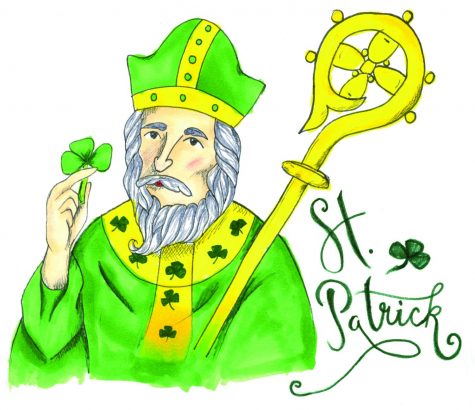
The true meaning behind St. Patrick’s Day is all but lost over the years. A true Irishman knows that St. Patrick’s Day is the celebration of Saint Patrick (c 389-460/461), a Christian missionary who flourished in 5th century Ireland. Patrick is considered the patron saint of Ireland as he is credited as the founder of Christianity in Ireland. And due to his training as a priest, he brought the ideas of the Roman alphabet, Latin literature, and the Celtic cross to the public. This is why March 17, the day Saint Patrick died, is celebrated as a national holiday in Ireland.
The most ironic thing about Patrick being the patron saint of Ireland is that he was not an Irishman. According to irish-genealogy-toolkit.com, Patrick was born in Britain to a Roman-British army officer and church deacon near the end of the 4th century. His privileged youth came to a sudden end when he was. That year he was abducted and put on a slave ship by pirates who had raided his parents’ estate, then taken to Ireland and served six years as a slave, tending sheep.
During his captivity as a shepherd, Patrick started to embrace his Christian faith in order to survive the harsh existence as a slave. His devotion to prayer and religion gave him the courage to make a daring escape from captivity when he was about age 22 or 23. Saint Patrick would say he had a vision from God that told him that it was time for him to leave Ireland and return home. He then set out on a 200-mile trek across Ireland and secured passage on a ship that took him home to Britain. Once there, his reunion with his family was not what he had hoped, so he left.
Saint Patrick decided to dedicate his entire life to Christianity. He went to France and spent the next 16 years studying to join the priesthood. When Patrick was in Europe, he claimed that he had another vision where an angel in a dream told him to return to Ireland and serve as a missionary. After being ordained a priest, Patrick returned to the land where he was once a slave to convert the Irish to Christianity.
The Irish at the time had pagan beliefs in which they worshipped multiple gods of the sun, sky, earth and water. Patrick wanted them to acknowledge the existence of only one God and Jesus as his beloved son. In order to teach Christianity to the Irish, Patrick made clever use of pagan symbols that were already in existence in Ireland. Thus started the legends about how Patrick was able to convert the Irish to Christianity. the Irish wear shamrocks on their lapels on St. Patrick’s Day. According to Irish legend, Patrick used the shamrock to illustrate the Holy Trinity of the Father, the Son and the Holy Ghost.
He superimposed the sun onto a Christian cross to to create what is now known as a Celtic cross. Patrick used bonfires to celebrate Easter because he knew the Irish used fire to honor their gods.
The Irish have always had an oral tradition of storytelling. One popular legend is of Patrick driving the snakes out of Ireland; however, there have never been snakes in the Emerald Isle. The Irish were speaking metaphorically about Patrick driving out the serpents representing evil in the Christian faith.
Before he died in 460 or 461, Patrick had served as a missionary for 29 years and had seen over 300 Christian churches built in Ireland.