
Milken Family Foundation – Press Photo
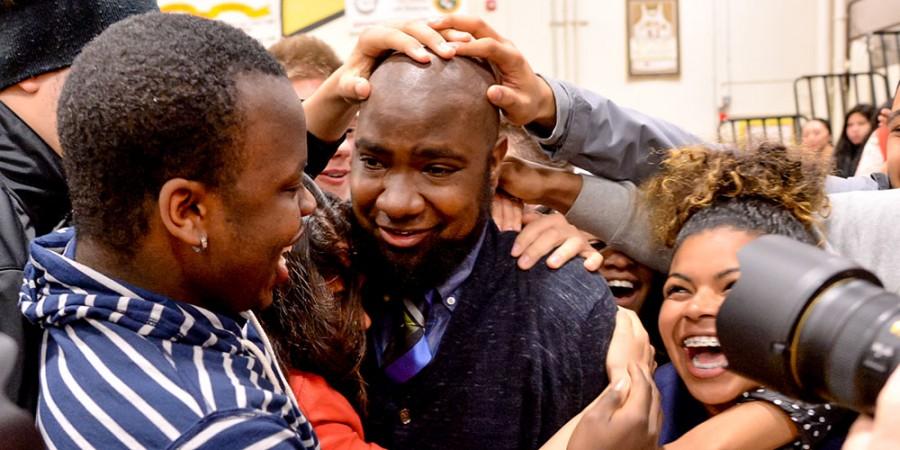
Students congratulate Gibbs-Bowling after Senator Patty Murray announce him as winner of the 2013-’14 Milken Educator Award.
Washington Teacher of the Year shares his story
Nathan Gibbs-Bowling is outspoken on issues facing educators
July 7, 2026
Nathan Gibbs-Bowling is a teacher of AP Government and AP Geography at Lincoln High School in Tacoma, and was named a Milken Educator in 2014, won teacher of the year for the state of Washington in September, and is now a nominee for teacher of the year on a national level. And if that weren’t enough, he’s a Pierce alumni, too.
Gibbs-Bowling emphasized the importance on the subjects he teaches, and why he teaches them: “Government is empowered to take away your life, liberty, and property. And if we don’t understand the powers of governments, we also don’t understand the limits of government and when the government violates our rights. And particularly in the era we live in, the era of #BlackLivesMatter, the era of political polarization, and the era of low voter turnout, it’s really important that I turn out citizens who understand government.”
He went on to say that most Americans are “fairly uninformed” about world politics and events, citing a Public Policy Polling study that stated of voters who believe Benghazi is the biggest political scandal in American history, 39% don’t actually know where Benghazi is, further emphasizing the importance of not just politics, but geography and the two subjects’ relationship.
When it comes to teaching techniques, Gibbs-Bowling said that he likes to get students to talk more than he does. “Whoever’s doing the talking is doing the most thinking, so if I’m doing all the thinking, I’m the one getting smarter. But that doesn’t help them.” Gibbs-Bowling uses a method known as Socratic Lecture, where he’s the one asking students questions, calling them to back claims with evidence and research. He says that, in doing so, “it forces students to own their learning.”
To engage students, Gibbs-Bowling takes advantage of what modern technology has to offer. He maintains a classroom twitter feed so that students can keep learning even outside of the classroom. “As far as I’m concerned, if a student is reading an article from the Atlantic Magazine at seven in the evening, that’s a win for me.” He also utilizes videos and podcasts in the classroom.
Next, he discussed Teachers United, an education policy advocacy organization created by teachers, of which he is a founding member. “The vision of Teachers United is to create policies that put students first. Essentially, the group was created out of frustration with a polarized education conversation here at Washington state. On one side you have reformers, and reformers sometimes have high in the sky educational ideas that aren’t based in practice. And then sometimes you have a kind of ‘no no no no no’ status-quo entrenched loud voice within the peripheral. And so our job was to get teachers who are effective and involved in positive conversation.”
Teachers United encourages teachers to get involved in legislation, such as signing up for committees and writing opinions and editorials to newspapers.
“One of the number one things educators can do is tell their stories,” says Gibbs-Bowling. “A lot of people have a lot of opinions about public education and if you look at the data, the vast majority of Americans have a very high approval rating of their neighborhood school, and the school their child attends, but low views of public education writ-large. And I think that’s driven by narratives in the media and by politic makers that our schools are failing, when in actuality, more people, not just round number percentage-wise, are graduating now than any time in American history. And not just that, a higher percentage of students are going to university and two-year colleges, a higher percentage of students than ever are taking Advanced Placement courses. I’m not a fool, there’s definitely work to be done, there’s a lot of work to be done on equity, and there’s a lot of work to be done on traditionally marginalized populations, but teachers need to redefine the narrative about education and tell our stories.”
When it comes to things Gibbs-Bowling thinks need to change in the education system, he said that it’s “a huge question.” One of the things he takes issue with is that the current educational policy model is created by elected officials and their appointees and is then often imposed on teachers and students without their consultation. “Sometimes that leads to wrongheaded policies, sometimes that leads to resentment, sometimes that lead to policies that have unintended consequences.”
Gibbs-Bowling says that his vision on how to make education better is to involve teachers earlier in the process. “Oftentimes when teachers are brought into policy making, they’re brought in at the end of the policy making process… what we really need is teachers involved in the initiation of policies and policy formation. And that’s the goal of Teachers United and that’s one of my goals this year as Washington State Teacher of the Year.”
When asked how he feels about his recent awards, Gibbs-Bowling stated: “In the big scheme of things, I don’t do this for awards, I don’t do this for recognition. Yes, teachers deserve more recognition for their work, but that recognition doesn’t need to and shouldn’t come in the form of awards, it should come in the form of being compensated as professionals, it should come in the shape of being viewed as professionals, it should come in the shape of being trusted with instruction decisions and treated like the professionals we are.”
To Gibbs-Bowling, the importance of teaching is undeniable: “I fundamentally believe to my core that teaching is the most important profession in the world, because it makes all other professions possible. If you look at your app designer, your oncologist, your landscape architect, whatever; that person before, was a student sitting in the classroom of an inspiring teacher. And given the importance of education and teaching to our society, it’s important that we regard teachers in an appropriate way. And that happens sometimes throughout the nation, but it’s inconsistent, and I think it’s important to elevate the teaching profession.”
Finally, Gibbs-Bowling answered what he considered the most important question: what advice would he give to struggling students? Five simple words:
“Go. Talk. To your teacher (or professor). I always say in my classroom, to my students: ‘I don’t know, what you don’t know, until you fail my test. So ask me questions.’ Ask. Questions. If you don’t know what’s going on: Ask. Questions. Here’s about what’s going on: Ask. Questions. If you think you know what’s going on, but aren’t sure: Ask. Questions. When you ask the question, you probably aren’t the only person confused about it, so even if you ask a question you think you didn’t understand, but you do understand, what you did is you’re helping somebody else.”
For those who would like to read more from Nathan Gibbs-Bowling, he hosts a website where he talks more about his thoughts on education. Find it at: http://www.natebowling.com/