
Navigating Education without a Compass
ACT’s Compass placement test is being discontinued, raising questions and concerns about what student placement alternatives will be put into place
July 7, 2026
The American College Testing (ACT) program has published the following announcement on their website, ACT.org, “A thorough analysis of customer feedback, empirical evidence, and postsecondary trends led us to conclude that ACT Compass is not contributing as effectively to student placement and success as it had in the past.”
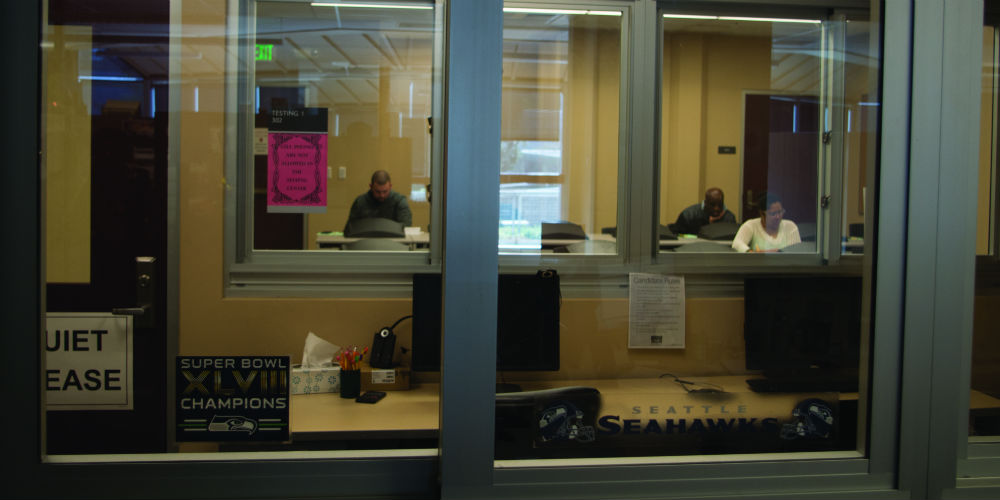
The Compass test is a placement test used in community and technical colleges. It is a computerized test that is untimed, adaptive, and measures skills in reading, writing, and mathematics.
The Compass test has been the lead placement test for colleges for decades, but this test, including the ACT Asset, Windows Compass, eCompass, and Compass 5.0, will discontinue on November 30 this year.
David Lippman, a mathematics instructor, shared his thoughts on the Compass test’s removal, “The whole placement process has always been a bit of a challenge,” Lippman said. “For example if we want to test someone to see where in 7 levels of math someone belongs, we don’t want to put them through 7 hours of testing to figure it out.”
Lippman added, “None of us are particularly sad to see Compass go,” Lippman said, “There were a lot of us who did not particularly love it.”
Lippman talked about how Pierce College plans to handle the Compass’ removal, “We’re always trying to find a way to find out where people belong, and it’s not always going to be easy.”
Lippman talked about how the Compass may not always be accurate. How some students may be placed into pre-calculus, but may have forgotten a certain subject in algebra that they need to know for pre-cal.
Lippman said the placement testing process will never be perfect, “The stuff I’ve seen suggests that 70 percent or so of students who were placed in classes because of the testing did just fine from where they were placed,” Lippman said, “Though there are also students who feel like the classes they were placed in were wrong.”
The study Lippman is referring to is a validation study of placement tests conducted in Ohlone College, where 74 percent of students who were placed into their math class by the Placement Test said they were placed into the proper class, whereas the instructors thought that 92 percent of students were placed into the proper class. The study’s summary, submitted by one of the college’s professors Wayne Takakuwa stated, “Students often completed a higher level math course in high school than the math course they test into at Ohlone.” Concluding that the student’s placement in math courses were lower than what they had already studied in high school, now being moved to less appropriate courses based off of the placement test’s results.
Lippman talked about what he called “a big push” called “multiple measures,” which he said means two different things: the testing for students on multiple courses, and to take into account multiple factors for when the student is taking the test such as where they are in life, or how long it’s been since they’ve been academically tested.
Lippman mentioned other types of placement tests schools are starting to use such as the Smart Balance, a new test being used in high schools that is being given in 10th or 11th grade, and if a student does well in that test they are then placed into college level courses.
But the one other system Pierce College is looking into, according to Lippman, is one that will have student’s placement be based off of their high school GPA. This would apply to both Running Start students, recently graduated high school students, and students who are returning long after acquiring their GED or high school diploma.
Lippman did, however, say that the biggest downside to this system would be that students who are returning to school, whether it’s been 3 years or 10, may have forgotten some important subjects they may have known well back in high school.
So a student who may have graduated with a 3.8 GPA may be placed in a high level class, despite having not been in school for years, and may have accidentally forgotten the level of subject matter that they are placed into. Lippman clarified that this was only one suggestion, not a solid plan.
One of the ACT’s competitors is the College Board’s Accuplacer, but Lippman believes Pierce College will look more into phasing out placement tests all together, focusing more on GPAs as a basis for student placement.
The Accuplacer is run by the College Board, the same organization that runs the Scholastic Assessment Test (SAT), the test for high school juniors and seniors. The SAT is also competitor to the ACT which covers grades K through 12.
“Recent studies have been looking at the accuracy of placement tests,” Curt Warmington, the English Chair for the Fort Steilacoom campus said, “The English Department had started research into this question prior to learning that Compass was going away. Personally, I think there is good reason to question the effectiveness of placement tests, and I’m glad that we are doing this work.”
“[The English Department] is still meeting and looking at options,” Warmington stated, “We have done research and have met 4 times so far.” Warmington talked about how there might be a taskforce that will be working on a solution over the summer, but the plan of appointing the taskforce is still in need of approval.
“We will probably use more than one assessment tool,” Warmington said, “But we are not sure which yet or exactly how we will use them.”
Though the Compass is being phased out this Fall, data via ACT eCompass will still be available through December 31.