
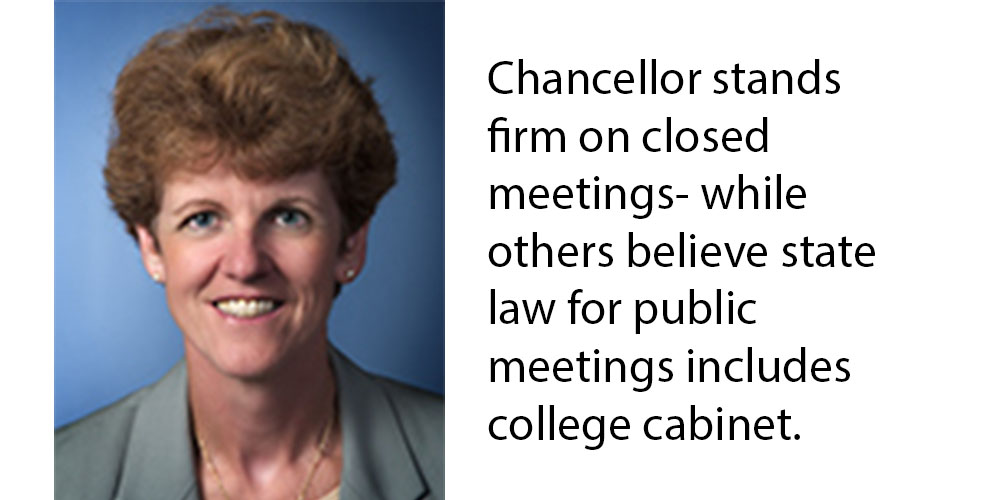
Chancellor stands firm on closed meeting
A former Pioneer editor and a media law firm believe state law for open public meetings includes college cabinet
July 7, 2026
The latest comment from the chancellor on a threatened lawsuit over public access apparently is: No comment.
At the May 5 meeting of the District Policy and Governance Council (better known as College Cabinet), the district chancellor, Dr. Michele Johnson, was asked by a Pioneer reporter to comment on a letter she received from the law firm of Davis Wright Tremaine over public access to the cabinet’s meetings. Johnson replied that she was not going to discuss that.
The Cabinet reviews all proposed policy changes such as sexual assault, plagiarism, smoking, and student discipline before those proposals go to the Board of Trustees for a vote.
The letter from the law firm is based upon an incident that occurred at the Nov. 12, 2015 meeting of the Cabinet. When Johnson discovered that a Pioneer reporter was attending the meeting, she yelled, “No! No press!”
The reporter, Dominic Wilkerson, was asked to leave the meeting.
Johnson spoke to the state assistant attorney general assigned to the college district, Linda Sullivan-Colglazier, who advised that the Cabinet meetings were not subject to the state’s Open Public Meetings Act (42.30 of the Revised Code of Washington). The Act refers to “governing body” of a state agency, such as the Board of Trustees. She advised Johnson that the Cabinet was an internal meeting and not that of a governing body and therefore could be closed.
In an email to Wilkerson, Johnson reiterated her position that the Cabinet meeting could, and would be, closed to the press.
“I knew we would have some trouble with dealing with the chancellor since she happens to have the assistant attorney general on her side of the ring,” Wilkerson said. “I needed to get a lawyer myself.”
Wilkerson believes the College Cabinet meetings are subject to the state law and should be open because of their influence on Board decisions. He talked with Frank LoMonte, executive director of the Student Press Law Center in Washington, D.C. LoMonte contacted Davis Wright Tremaine, a Seattle legal firm with a specialty in media law. Tom Wyrwich of DWT in turn spoke with Wilkerson.
After some legal research, Wyrwich agreed to pursue the issue. On April 18, Wyrwich sent a letter to the chancellor stating that he believes that the Cabinet qualifies as a meeting that should be open to the public under state law. Wyrwich argued that the law applies not only to a governing body but also to a “committee thereof” when “the committee acts on behalf of the governing body, conducts hearings, or takes testimony or public comment.” Wyrwich said in the letter, “There is little doubt the Cabinet is such a committee.”
Opening the Cabinet meetings to the to the public is not only a legal necessity, Wyrwich wrote, but “it is also the right thing to do. The decisions of a body that governs and makes policy for a public college should not be made under the cover of darkness; the students and the community have a right to see how the decisions that affect them on a daily basis are reached and made.
“Open meetings enrich public debate by ensuring all affected parties can take part in the discussion,” Wilkerson continued. “They also preserve the credibility of public institutions by assuring that they act transparently; conversely, secrecy fosters mistrust.
“We ask that the Cabinet open its next meeting in accordance with state law. Although we are prepared to pursue litigation on this matter if necessary, we sincerely hope it need not reach that point,” Wyrwich concluded.
On April 28, The Pioneer received an email inviting both Pioneer Editorial Manager Caleb Hensin and the Puyallup Post’s Editor-in-Chief Grace Amsden to attend a portion of the May 5 Cabinet meeting discussing “The Open Public Meeting Act and Shared Governance.” The two editors were told that they could attend only that portion of the meeting, which would be the first agenda item.
At the May 5 meeting, Johnson said: “Recently questions have been raised about whether Cabinet meetings are subject to the Open Public Meetings Act and whether the way that we are operating is a violation of the Act.” She added that she and the college have “a strong commitment” to their obligations to open government, and that they value “inclusion and openness.”
“We have been looking at whether or not the practice we have been engaged in is consistent with what the board’s intention was,” Johnson said, and whether that practice meets the requirements of the Open Public Meetings Act. “I’m satisfied it is.”
However, Johnson did mention a need for “clarity” regarding policy. She said she will continue to work with the Board of Trustees and the assistant attorney general “to see what we need to do to make sure that we can clarify what the Board’s intentions are, and so that there is no confusion either internally or externally. And so we’re still working on what are the next steps to do that.”
She added, “That’s about as much as I want to talk about it today until the Board has actually had the opportunity [to discuss it].” Johnson did not allow the invited reporters to ask questions until after the meeting was finished. Despite the earlier directions, the editors were allowed to attend the entire meeting.
The next scheduled meeting of the Board of Trustees is May 11, at 1 p.m. at Pierce College Puyallup. This meeting is open to the public.
After the Cabinet meeting, in response to asking her position on the matter of open meetings, Johnson said that she essentially “has no position” until the Board meets, although she had earlier said that she “is satisfied” that the Cabinet is meeting the requirements of the open meetings law.
When asked if this was her response to the letter sent by David Wright Tremaine, Johnson said, “I have nothing to say to you about it. I consider them separate issues.”
“The Pioneer, over the years, has taken on several tough subjects so being excluded from a meeting that seemed to be open to the public was not right,” Wilkerson said. “There were other people not on the Cabinet sitting in the [Nov. 12] meeting,” Wilkerson said.
Keeping student press from such meetings keeps student journalists from learning about the processes of government, journalism, and how to vet stories, Wilkerson said.
“With me getting a lawyer and possibly letting this go to litigation, this can show students to stand up for what they believe is right,” Wilkerson said.
Wilkerson added that he believes that students should be made aware of the policies that are discussed at the Cabinet meetings before they are voted upon by the Board.
“The main thing I hope for is just access back to these meetings. My time at Pierce is ending soon, since I will be graduating, and I want what is best for The Pioneer and the students,” Wilkerson said.