
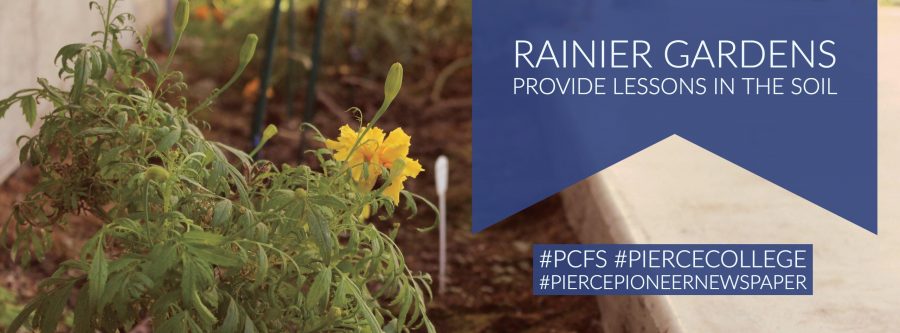
Megan Sokol/Staff Photographer
One of the garden plots in the Lower Winter Garden.
Rainier Gardens provide lessons in the soil
The Biology department unearth years of work on the Upper and Lower Winter gardens and its contributions to the STEM field
Megan Sokol, Staff Writer
July 7, 2026
Underneath the second floor in the Rainier building lies a reference library teeming with ferns and gangly vines. Opposite to a biology lab is a shelf full of succulents, flowering into tiny rose buds.
Plants like moss, angiosperms, ferns, and cyclanthus are growing all over the Rainier building among a sea of botany in the Upper and Lower gardens. These humble projects draw many lessons for aspiring biologists and natural scientists; from scheduling the next planting season, to illustrating the plant’s structure.
Professor Elysia Mbuja of the Biology department helped develop the Lower winter gardens, along with Robert Thissen and Physics Professor Les Uhrich, who planted the Banana trees a few years back.
Mbuja recalls her previous classes, who were fortunate enough to help plant the vegetation. “The lower winter garden used to have a slope and had different ferns and cyclanthus on it, but had to cleared out so that the windows can be cleaned. When I saw that, I thought ‘we can use this as a teaching garden,’ and so our [Biology 213] students have actually planted all of the plants there, in the Summer and Fall.”
Not every plant was planted into the garden by a student. “Some of those plants were added by a few instructors.” Said Professor Mbuja. “The rose clippings were contributed by a professor.” Said Mr. Thissen, “of course, this is not a personal space for people, but with the appropriate faculty members’ permission, a professor can contribute to the garden.”
The garden is an interdisciplinary foundation. It involves botany, biology, and even nutrition. Many professors and staff members strive to work together. “We had to work with facilities to work on irrigation. Hopefully in the future we could install a couple misters as well” Said Mbuja.
Mr. Robert Thissen, who tends to the lower winter gardens is enthusiastic for the garden’s potential, but must anxiously wait for Spring to return.
“Since we do not have a greenhouse, the plants must rely on the existing climate which is usually very cold.” Thissen pointed to the withering vines of a gourd that a student planted and continued. “I try to spray some soap water on the plants to treat them, but the climate still deeply affects them.” Said Thissen.
If the Biology department can find a way to supplement the conditions necessary for the gardens, there could be partnerships in the future. “I think it would be a great idea to collaborate with nutrition or even ECED.” Said Mbuja.
With nutrition and the Early Childhood Education program possibly in the mix, there could be a multitude of research possibilities in their path. Already plotting space for sorghum, beans, peas, and dwarf corn, the garden is teeming with potential.
Pierce Pinnacle • Copyright 2026 • FLEX WordPress Theme by SNO • Log in