
Read a book, celebrate National Book Month
Book reviews in recognition of January being National Book Month (part 1)
July 7, 2026
‘The Hobbit’
by J.R.R. Tolkien
Review by
SuYoung Park/Staff Writer
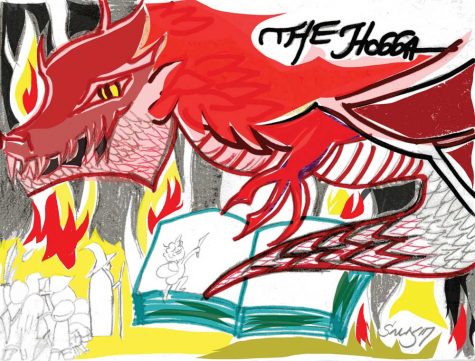
‘The Hobbit” begins with Bilbo Baggins, a hobbit, a shorter-than-average-size man. He is an outcast who is accustomed to being alone in solitude. Then, his life turns upside down with adventures when random strangers, dwarves and a wizard force themselves into his ordinary life. They go on a quest to slay a legendary dragon. Through a series of events Baggins and his dwarven friends have to overcome, Tolkien talks about different kinds of happiness.
In the adventure of Baggins and his companions, they find that no one — alone — can be a hero. All have their shortcomings — but all cooperate with each other. Baggins, who is at first looked down upon because of his small stature, becomes a hero in the story as he endures life challenges and does not give up.
That is what life is about — not giving up but finding creative ways to face challenges. It is about realizing and learning about ourselves along those paths we took. So, share this book with loved ones who struggle with their own insecurities and doubts. It helped me understand what life and community is about. I really hope it will speak to others that might need that same encouragement.
We don’t have to fight the battles by ourselves.
‘Black’
by Ted Dekker
Review by
Debbie Denbrook/Staff Writer
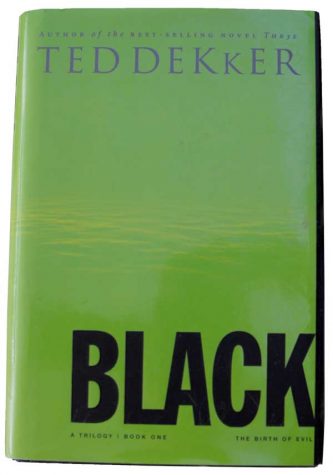
“Black” by Ted Dekker is fantasy and romance combined. It starts off with the main character, Thomas Hunter, being chased down an alleyway in Denver, Colorado. Thomas is shot in the head and wakes up in a different world with a colored forest, furry talking white bats and a beautiful woman. But when he goes to sleep, he wakes up back in Denver and starts questioning if Denver is a dream world. Each time Thomas goes to sleep, he wakes up in the other world and his actions in each world impacts the other world.
“Black” is the first (or perhaps the second book) in the Circle series, it depends on how the books are read because the series literally is a circle. So if one is looking for a good solid ending, this is not the series to read. But “Black” is just a beginning, Dekker’s other books and series will frequently tie into this world that he has created in Black. So for those that can’t get enough of this fantasy world, it doesn’t need to end.
Other books by Dekker can be found at www.teddekker.com.
“The Hitchhiker’s Guide to the Galaxy”
by Douglas Adams

A portrait of Douglas Adams who wrote “The Hitchhiker’s Guide to the Galaxy”.
Review by
Lorelei Watson/Staff Writer
What do you do when your friend shows up to tell you that everything you know will be destroyed to make way for an intergalactic highway?
You join him on his journey to hitchhike around space, of course!
Along the way, you’ll meet a handful of peculiar friends, hear some unique poetry — and even find out the answer to a question, seven and a half million years in the making!
If a blend of science fiction and comedy are your cup of tea, pick up a copy of “The Hitchhiker’s Guide to the Galaxy.”
“The Walking Drum”
by Louis L’Amour
Review by
Marji Harris/Staff Writer
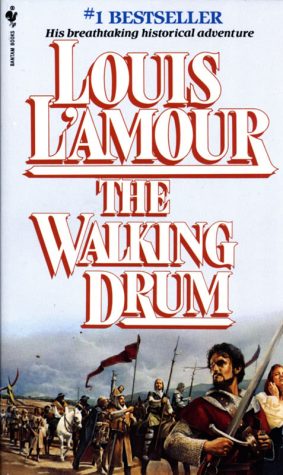
I have never held a Damascus dagger, but I can tell you of the steel, of the fine edge of the blade. I have never been a slave aboard a pirate ship, but I can tell you how the weight of the chains feels as I pull on the oars. I have watched as scholars come from all over to create books that catalog a civilization, written works that would fill Carthage. I have seen the mark that the Phoenicians, Greeks and the Moors left in their architecture throughout Spain and Eastern Europe. I looked for a candle in the dark houses of Europe as superstition about education and Christian beliefs clashed. I knew Paris when she was still stinking of rotting carcasses and raw sewage, far from the jewel she is today.
“The Walking Drum” records Mathurin Kerbouchard’s travels as he searches for his father. Twelfth-century Carthage and Córdoba become bustling trading hubs, full of color and scent, not buried in some dusty history book. Politics among the Byzantine Empire come to life, played out by Abd-al-Mumin and al-Hakim. Slavers, merchantmen carrying Persian rugs and spices, all tell of life from the Horn of Africa to Amorica (home of the Gauls).
There are few storytellers that have been able to match L’Amour’s gift. “The Walking Drum” is perhaps one of his best works as he weaves a tale full of politics, intrigue, betrayl, love, and life.