
Questions spur Black Lives Matter movement
July 7, 2026
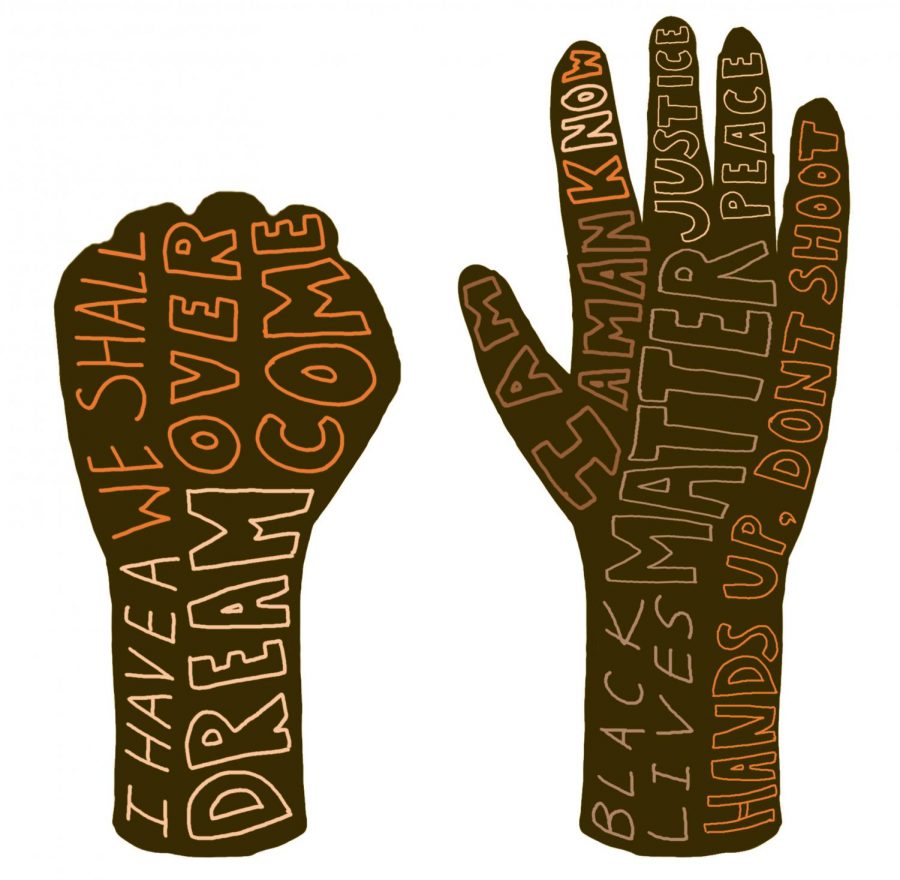
It is supposedly the age of diversity and acceptance. The nation even progressed to electing a black president, who served two terms in office.
Tammy Pyne, a professor in the Business and Social Science, remembers a speech then-Illinois Sen. Barack Obama gave at the Democratic Convention in 2004 in which he said there are no red states, there are no blue states, there is only the United States.
“That opened the floodgates, opened people’s hearts and souls because that is what they really wanted. They wanted us to come together. He gave us that hope and that change and that is what he was pushing for all of us to be,” she said. “It is why people could reach out, why he could say, ‘This is what our government could be.’ The connection between us having a biracial African-American president to now (Black Lives Matter) is the fact of how justice is being handled in the criminal justice system, that is the issue.”
Yet, people are still taking to the streets in protest, crying for justice. At first glance, it appears that the Black Lives Matter movement is a recycled civil rights agenda left over from the 60’s.
Some say the Black Lives Matter movement began in Ferguson, Missouri. The reports of an unarmed black man being shot by police seemed to be the match that lit a fuse.
High-profile cases, such as Trayvon Martin, a 16-year old boy visiting his father in a gated community in Florida, whose only crime was to talk a walk late at night for a bottle of tea and some candy, help to fuel that fire.
The argument has been made that if people would just cooperate with the police, there would not be any problems.
And in the case of Martin? Pyne has a question of her own.
“Why is a community watch person getting into an altercation with a 16-year-old? It comes down to common sense. What was it about this young man that was a threat? A 29-year-old man should be able to say ‘Hey, young man! What are you doing?’ Now, if the 16-year-old said, “It’s none of your (expletive) business, I’m here,’” she said. “Even if all the 16-year-old did was talking smack, he still has bottle of tea and a package of Skittles that he bought. Why can’t he just be allowed to go home?”
In the case of Philando Castile, he was a pillar of the community – loved and active at the charter school where he worked, according to a report published by the Washington Post. The report said: “What the police officer who shot Philando Castile said about the shooting, there were a number of contributing factors. The girlfriend’s account and the video dashcam from the officer give credibility to the testimony that Castile was doing everything right, yet the officer was jumpy and not in control of his emotions; he shot Castile out of fear.
These stories, along with many others, have contributed to Black Lives Matter.
“It is to say that people are tired of the injustices done to black and brown people. And it doesn’t mean that only black people matter. If you flip the script, then we wouldn’t have (Black Lives Matter),” Pyne said. “This is not a perfect society, it isn’t a fair justice system. The only way for our youth and the mothers in the movement, they are really tired. It is like civil rights No. 2. These are just two of a multitude of stories. It is part of a pattern. It’s the powder keg of the (Black Lives Matter) civil rights.
“We can jump right into Tamir Rice, 12-years-old, who had a BB gun. In the video, it took the police 2 seconds to decide to shoot. Flip it around, what if that had been a Caucasian boy?” she said. “Would people be in an uproar? I would hope so, but it would be a different kind of uproar.”
Jane William, a student pursuing an associate of arts in medical coding, can see several contributing factors to the protests and why they are still necessary.
“If so much stuff has been hidden too many times, it’s like nothing is being done. How many black people have been killed? How many white people have been killed? How much of it has been ‘what is really going on in that community?’ That’s what it’s really about to me,” William said. “It more about why is it taking so long for us to protest? I think it has taken this long to get fed up, like in the case of Ferguson.”
She wants to emphasize the focus is not that black lives matter more than other ethnic races and backgrounds.
“It is interesting to me how we have evolved from how Martin Luther King Jr. did his protest versus what we are doing now. It is not like the other races do not matter, but if the right audience hears it, then every other ethnic background will ask ‘Is this happening to us, too?’” she said. “What it is specifically about black lives that makes us alone? It seems we are still segregated.”
Pyne said the justice and policing system is stacked against people of color, as shown in cases where the outcome was different when the suspect was white.
“You have a gunman in Aurora, Colorado, who killed how many people? Yet the police were still able to contain him. Las Vegas hotel shooting, he killed himself. Dylan Roof, the young man involved in the Charleston, Virginia, church shooting in 2015, taken into custody. (The police) even took him to Burger King. What do you say about those people, when the…person of color is “acting out” gets shot? What happened to shooting in the leg? Why shoot to kill?,” she said.
“We charge our police officers to protect and to serve. When they become judge and jury at the same time…there have been instances where excessive force has to be used to contain the threat, but it cannot be the rule for all. This is happening all throughout the U.S.; it is not just one particular area….there has to be a concerted effort for people to come in with cool heads. I know it is a tense moment, it can be especially so for those who have gone to war, then go into law enforcement.
Another contributing factor is the apparent lack of accountability, Pyne said?. As in the case of X and X, officers did not take ownership for their actions. And people do not feel satisfied with the outcome of the internal reporting from the police agencies.
“If they said, ‘We are sorry, this was a mistake that we took this person’s life,’ then yes, you would probably have less people protesting, because they owned up to it,” Pyne said. “It is when they don’t own up to it, not being honest and truthful, and turning a blind eye, this is why you have Black Lives Matter. They want justice, they want reform, which is something we all should want.”
*For more statistics go here: www.naacp.org/criminal-justice-fact-sheet/