Living With Autism
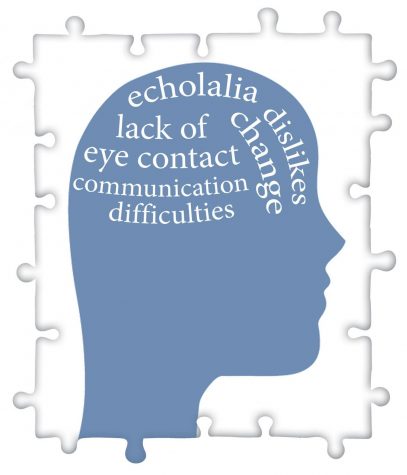
I am a 45-year-old student of Pierce College at Fort Steilacoom. April is Autism Awareness Month and because I have autism, I would like to share what it is like to live with autism.
Autism is a developmental disorder that severely limits an individual’s ability to socially interact with other people. People with autism find it difficult or nearly impossible to communicate. They live in an isolated existence that is separate from the real world.
Often when people think of autism the first thought that comes to their minds are children. However, autism does not go away when those children become adults. People who are born with autism must live with this disability all their lives. This is why I want to raise the public’s awareness of the plight of adults with autism who struggle each day to interact with a world that may not understand the social limits caused by autism.
In the 1970s when I was born, autism was not yet universally understood as a developmental disability in the United States. All of the experts in child psychology said that I was an insolent child. The anti-social behavior that incessantly got me sent to the principal’s office was considered to be deliberate instead of being the result of a disability. When I attended high school, the teachers often lost their patience with my inability to learn quickly. I simply did not know that I was not personally responsible for my inability to communicate and for my social ineptitude.
I did not understand what autism was until I watched “Rain Man,” the Oscar-winning Best Picture of 1988. Dustin Hoffman played Raymond Babbit, an autistic savant. I was mystified by the eerie similarities between Raymond’s behavior and my own. Raymond never made eye contact and did not possess any social skills. This film could have been about my life. I finally learned the truth about my afflictions when I was 22. I had been seeking treatment for depression and was diagnosed as having clinical depression and autism.
Once I started taking medication and seeing a therapist, my world changed for the better. I finally got the courage to leave the house and interact with the public. However, my autistic behavior often causes negative social interactions with other people. My autistic idiosyncrasies are just something I have learned to live with.
I still find it difficult to be in public places. I get tense when I am around crowds of people. I like quiet environments because I cannot tolerate loud noises. I don’t like crowds of people because the sounds of people incessantly talking drives me insane. This is why I go to the cafeteria an hour before everybody else does. I want to avoid the torture of hearing people talking and laughing at the top of their lungs.
I have an affliction, common in autistic people, called echolalia, which is when I repeat the sounds I hear around me regardless of the consequences of my actions. Unfortunately, the noises I like to repeat are the sounds of other people’s voices. The people around me often react in a belligerent way to me imitating the way they talk. I don’t realize I’m doing this until it is too late.
I cannot promise that I will stop doing this because it’s a part of my disability. I can only try to catch myself before I imitate a sound, whether it’s a car, a microwave, a bus or a person.
I often am perceived by other people as a cold and rude person because I do not make eye contact. I cannot look at people in the face when I am taking to them if I even want to talk to them at all. I seldom make conversation with people even if they are acquaintances. I don’t have any inclination to say hello or goodbye to other individuals. I am the silent type at college because I never learned social norms as a youth. I was bullied in high school so I learned to avoid people, a hard habit to break.
I am a bachelor and will be one for life. I like being able to retreat to my home at the end of the day and enjoy the silence of being alone. I can give the public only so much of my time. I need time alone to recover from the stress of being around people.
I also cannot remember faces or names. I have to have something to connect to in my head. Usually that connection is a song or something I saw on TV.
I don’t like change in my world. I like things to be the same. For example, I was forced to buy a new TV after the one I had for 15 years croaked. I am used to using one button on the tuner. I now have to learn how to use at least ten buttons on three different tuners if I want to use the TV and DVD player. I had to write down the directions because that is the only way my brain works.
My mind is incapable of understanding verbal commands, only the written word. I am still finding it hard to adapt to the new technology involved with using the new TV. I know that after repeated attempts to learn I will adapt. This is how my autistic brain learns new information, through repetitious studying.
Whenever I get frustrated at school my depression will take over. I excuse myself to go to the restroom because I don’t want people to see me crying. Some people can control their emotions in public. I came from a generation where men were not supposed to cry. I often find it hard to not show emotion because of my depression.
I try very hard to use logic to suppress my emotions, just like Surak taught the Vulcans in “Star Trek.” I have also spent many years studying Buddhism, which has helped me find peace and serenity despite having a mood disorder.
I hope that my words will help my fellow students to have a better understanding of autism.