New chief diversity officer hopes to dismantle barriers in education
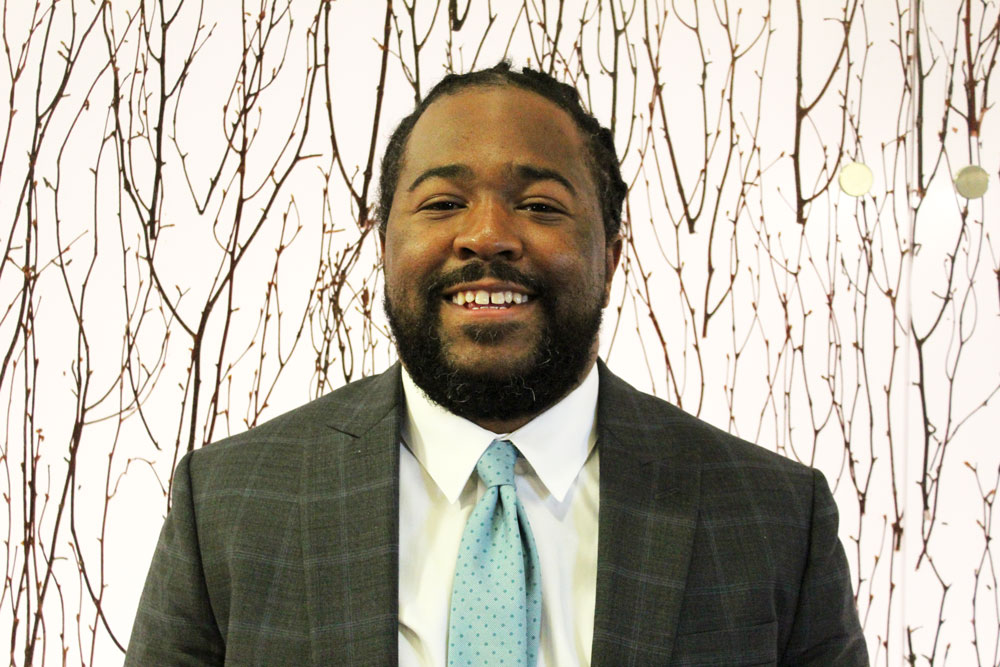
Charlie Parker is Pierce College’s new Equity, Diversity, and Inclusion Executive Officer. He plans to center his approach on accessibility.
Charlie Parker wants to use his life experiences
to inspire students to reach their full potential
It would be easy to miss Charlie Parker as he walks around on campus. With his young face and dreadlocks, he looks more like a student than Pierce College’s new Equity, Diversity, and Inclusion Executive Officer. Yet there is so much more to him than meets the eye.
He has a talent for creating sustainable opportunities for struggling people. “I like to affirm, acknowledge, and empower what is already working and support that and then float to where the gaps are,” Parker said.
His journey began in North County, Missouri. Kids who grew up in the Ferguson area often did not go on to college. The measures taken at his learning centers were designed more for protection, not education.
“I come from a place where school is not necessarily the safest place that you can be. So, schools in my neighborhood looked more like juvenile detention centers than they did education institutions,” he said.
Parker went straight into the workforce after graduating, fully expecting that he was finished with his education. Eventually, he worked his way up in to a middle management position in the information technology industry.
He didn’t see college as an option for himself until he met Angela Brown, a recruiter who encouraged him to attend Lewis and Clark Community College in Godfrey, Illinois. Through her, he began to think that maybe he could thrive in a college environment with the proper resources.
Brown also connected him to TRIO, a federal student support organization that is specifically designed to target underprivileged youth, as his first work-study job. He eventually transferred to a four-year university, the University of Missouri to pursue mass communication.
In undergraduate and graduate school Parker studied everything he could surrounding policy and communication because he knew it would help him acquire the toolset he needed to help his community. He wanted to get to the heart of why and how a system could support communities with so much inequity. “A lot of our policies were designed to disproportionately affect certain communities,” Parker said.
Graduate school also brought home another lesson for Parker. The expectations and the stereotypes surrounding higher education were reflected in his classroom’s demographics. “I was probably one of two African Americans in my class or people of color in general.
After experiencing the effects of thriving in an educational setting, giving back to his community was one of the first things on Parker’s mind. “This is an opportunity to be able to have a space of growth and get resources to be able to understand how the workforce works but then also how academia works,” he said.
Two key positions at University of Missouri helped prepare him to be a voice for EDI. When he became the University of Missouri’s first black administrator, he was also the youngest. Dealing with politics and a diverse population gave him valuable insight in how to make effective changes within higher education.
He also served for a time as a lead Title IX Investigator. Investigating sexual assault and sexual harassment at the university and gender equity in sports programs showed him how he can use his position of power to make a difference as a black man. Seeing a person of color made it easier for more communities of people who weren’t reporting incidents to step forward.
The EDI job description for Pierce College caught Parker’s attention. The opportunity to support equity, diversity, and inclusion and make an impact was appealing. “What attracted me to this role was dismantling barriers or systems of inequity,” he said.
Parker’s message is simple. His life experiences can be used to be a guiding light that other students can follow. He knows first-hand the barriers that stereotypes can create; he can also show how to break down those barriers.
Part of his vision is to create pathways beyond high school. By focusing at the middle school level, students can be better prepared for the workforce. Opportunities for a global education can reach more low-income students and broaden their education further.
Parker continues the legacy that Angela Brown taught him. His daily mission is to leave spaces better then when coming in. His message rings with encouragement. “You can be in the same space that I am. You can be better than I am,” he said.