Valerie Ettenhofer
Staff Writer
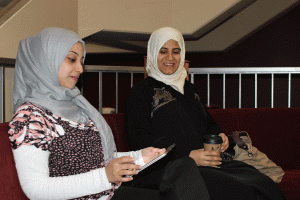 For most students, simply ‘fitting in’ seems like the easiest way to make it through school. For the Islamic women of Pierce College, standing out is a testament to faith and tradition.
The Islamic Qur’an stresses the importance of modesty in dress, and most women abide by these standards by wearing hijabs and abayas, flowing cloth that covers the hair and body respectively.
Reham Ali, a Saudi Arabian Fort Steilacoom student whose bilingual friend group all honor Muslim tradition with traditional garb, explained that women aren’t so different internationally. “All people here are nice and welcoming,” she shared. “We have our religion and there are rules…just like any religion.”
Ali explained that style differs when in the presence of men, and that women can wear what they choose when in the presence of fellow women.
This may strike some as an unfairly male-driven system, but Puyallup President Colette Burnette, who cultivated friendships with devout women while living in Turkey, believes that it is just another way of demonstrating strength and beauty.
“We [tend to] think, ‘Oh, they’re being submissive, they’re being humble, why do they dress like that?’, the whole American thing,” Burnette stated. “I came to know that their husbands actually revered them…They are humble in a very respectful and positive way.”
Ali also commented on the hot-button issue of educating women in the Middle East, saying that Saudi Arabia has an impressive education system that allows its people not only a higher average level of education than some other Islamic countries, but an earlier start to schooling as well.
The issue of global education has moved to the forefront of international media since the attempted Taliban shooting of Malala Yousafzai, a young Muslim advocate for the education of Pakistani women. Since surviving a shot to the head last year, Yousafzai has become the youngest nominee for a Nobel Peace Prize and continues to promote equal education.
“I think [in Pakistan] there’s a lot of hate against women—’women should stay at home, women should just serve for their husbands, not go out, not get an education,” said Ali.
“Education is a basic human right, so all people should get this. All of us should support Malala and what she is doing.”