Holly Buchanan Staff Writer
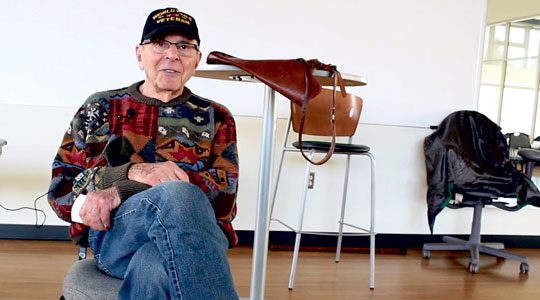 The chairs were full of students and faculty members who waited to hear the 91 year-old Rebel Without a Cause screenplay writer share his secret of what it took to become a renowned storyteller.
Stern grew up with his uncle Adolph Zukor, who founded Paramount Pictures and with his cousins, the Loews, who had control of Metro-Goldwyn-Mayer (MGM Studios). Arthur Loew, Stern’s cousin, was the person who pushed him to become a screenplay writer.
He attended the Ethical Culture Fieldston private school in New York, back then known as The Ethical Culture School. This private school had a mission to pursue social justice, racial equality, and intellectual freedom, and was one of Stern’s outlets to becoming a writer.
“The school had a great emphasis on the art of creativity,” Stern said. “We were trained to receive through our pores, what was needed in the world.”
The outcome of learning from The Ethical Culture School led to Stern participating in the Selma to Montgomery marches in 1965, protesting for black people to have equal rights. Among the protesters was Martin Luther King Jr.
“We all rallied in a muddy field outside of the city, without any security except our own because the local police were turning their backs on us, ”Stern said.
Thousands linked arms, blocking cars from passing. “Everyone you could think of made that march. There was an amputee who made that march on crutches and there were priests and rabbis and swamis,” Stern said.
Every experience has an opportunity for a record that people will be interested in. “Wherever you look, wherever you can accept and empathize with people, is where your story comes from,” said Stern.
Stern shared that aside from learning how to write in school his source for writing came from being in World War II, the Battle of the Bulge, where he earned a Purple Heart. During the war he recorded everything he saw and felt.
“You have to have notebooks all the time because your memory, unless you’re a prodigy, is not reliable,” said Stern. His experience in the war was accounted for in his film Summer Wishes, Winter Dreams.
The feeling Stern gave audience members was that of encouragement, but not just for writing, but also for living life. No experience is too much to handle when it can be turned into a story that will help others.
“You have to drink everything that will help you be you. You have the best story to tell. That story can save other people,” Stern said. “Even your weaknesses are loveable.”
In many of his films, the characters are taken from people he knew, like his parents. In Rebel Without a Cause and Summer Wishes, Winter Dreams the parent’s characters are identical with his own Mom and Dad. When showing the script to his Dad he reacted by telling Stern not to show his Mom. And when Stern finally did show her she said, “ Well I wasn’t born yesterday. I can see what I’m reading, you better not let your father see this.” Summer Wishes, Winter Dreams was one of Stern’s favorite films but least successful.
“To reach other people we have to share ourselves with other people,” said Stern
“We have to share our agony and our joy and our masturbation and our first vomiting and go in search of it, go and search all over the world to mate with everybody, to lock arms with everybody.”
To go in search of life and take everything you can from it was Stern’s most stood by guideline, to becoming a better writer and writing something people are interested in.
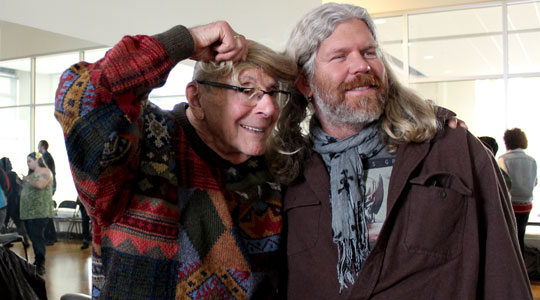 Stern has a passion for life that he stresses other people should have. “The details of a stain on somebody’s knee or the question of why it’s on somebody’s rump, all the things that you notice about a person how they cover themselves up, how they hide from other people, and how they engage with other people, are all details to get down in writing,” Stern said.
“And to approach other people you don’t know and buy them lunch and get their biographies and their autobiographies in exchange for yours, is what you have to do to find your characters, to find the truth of your characters.”
“With Stewart’s films it’s not about the head and the equation but about the heart and the poetry,” said Denise Hartley, English and humanities coordinator. “That’s what I get from Stewart as a teacher and a writer, is love and humanity.”