
PlutoPalooza is a Science Dome Hit
The universe doesn’t seem so far away as New Horizons flies by Pluto, taking photos that NASA expects to see in a year.
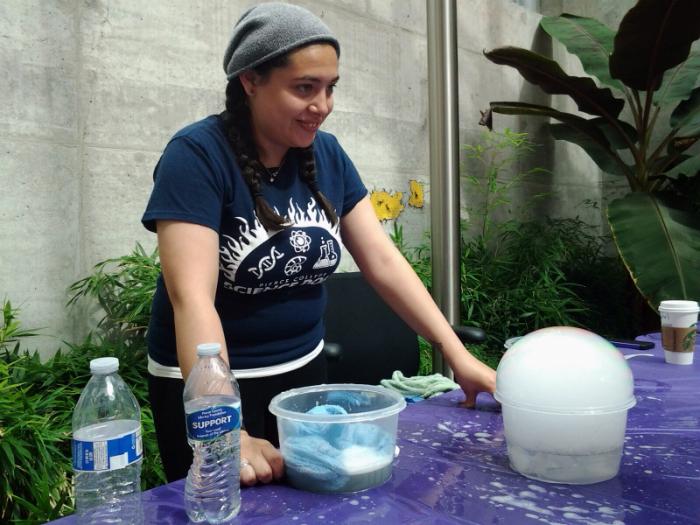
Sasha Amadore, a science dome coordinator teaches about Pluto’s atmosphere.
July 7, 2026
Pierce hosted Pluto Palooza, a celebration of the New Horizons spacecraft as it flew by Pluto, taking the most detailed photos to date of the dwarf planet and its moons. The photos are expected to be received by NASA sometime next year.
The event included feature presentations in the Science Dome planetarium, interactive science activities for kids, mini-lectures, and skygazing.
The Pierce Science Dome presented two features, “Pluto, A New Horizon” and “Dream to Discovery”.
“Pluto, a New Horizon” discusses Pluto’s journey from discovery to its reclassified as a dwarf planet and to the New Horizons flyby. “Dream to Discovery” took the audience inside NASA and through the processes required to get New Horizons into space. As stated in “Dream to Discovery”, “When humans dare to dream, we create truly amazing things.
While waiting for the next planetarium showing, children and families were encouraged to participate in many activities.
Outside of the Rainier building, children designed paper rockets and shot them up in the air. Families could gaze in the sky through high powered telescopes that were provided by members of the Tacoma Astronomical Society.
Inside the rainier building, families created planets, controlled planets, learned about constellations, and popped Pluto’s atmosphere.
In an activity set up by Chad Ellington of Natural Science Division, participants were able to see how a gravitational pull creates orbits. On a black, round canvas, Ellington would place a weighted ball in the center to represent a Sun. Children would then release marbles from various places along the canvas. The marbles would for an orbit and eventually gravitated closer to the Sun.
Another station allowed participants to create Pluto and its sister-moon, Charon. The object of this activity was to put clay to represent Pluto on one end of a craft stick and clay to represent Charon on the other end and create a balance between the two from a fixed point on the craft stick. If one side outweighed the other, then Pluto and Charon in clay form were not proportional to the real Pluto and Charon. This game of trial and error was a favorite to many of the visiting kids.
A fan favorite for the kids was a station that allowed participants to “pop” Pluto’s atmosphere. In a bucket filled with sublimating dry-ice, a layer of bubble-soap is laced across the rim of the bucket. The carbon dioxide being released rises into the soap, creating a bubble.
As it rose, children popped the bubble. This explained how Pluto constantly builds its atmosphere (sublimation of the dry ice), but as a solar wind comes in contact with atmosphere (the bubble), it pops and Pluto loses its atmosphere.
Families also learned about constellations and how to track them, ultraviolet telescopes that track water on other planets, and other various tidbits about Pluto, planets, and NASA.As stated in “Dream to Discovery”, “When humans dare to dream, we create truly amazing things.
The Tacoma Astronomical Society hosts lectures, dome presentations, and indoor workshops each month at Pierce. The Science Dome presents features on Fridays and Saturdays. “Dream to Discovery” can be seen again on Sept. 25 and “Pluto: A New Horizon” can be seen on Sept. 26. For more information and a list of shows, visit the science dome page on the Pierce website.