Pierce College’s Office of Student Life has many clubs, which are paid for in part through students’ tuition fees. But why should students’ money go to paying for clubs they may not be in?What do clubs provide that justifies pricey tuition increases? In the current internet age is there even a need for college clubs? There are plenty of ways for students to interact online rather than using costly college resources. After I talked to several people involved with Pierce’s clubs, I was shown why clubs are a key part of student’s college lives.
Iopu Ignacio, District Manager for Clubs and Organizations, including Phi Theta Kappa Honor Society, believes that the impact of clubs on campus is a positive one. He had this to say when asked what students get from clubs;
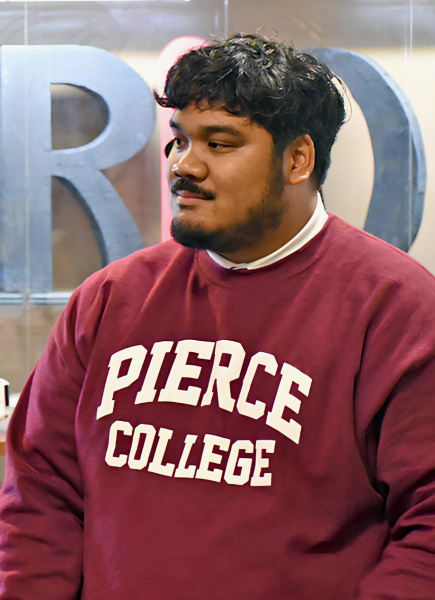 “…What [students] get out of [clubs] is a sense of belonging, inclusiveness, a sense of community and fellowship. I think a lot of people come to college and they want to go to class and then go home, but I think there’s more than that on campus that we have to offer…”.
Ignacio also spoke on why it is important to support these clubs financially.
“When you become a club, you can use these funds to create an event that you want, create atmosphere and communities that you want… the money that is put in tuition is being utilized for the engagement of the college experience that students need.”
Ignacio was then asked if he had ever seen that sense of club community in person before and he had this to share.
“Two weeks ago, I went to Game and Anime networking club on the Puyallup side. And to my surprise there were two different clubs there. There was obviously Game Anime Network club there, but then also Tabletop Gaming. So, [Game and Anime Networking Club] like to meet with their club but then also have other clubs at their meetings as well.”


The message from Ignacio was clear, student-run clubs help make the college community whole. They round out the experience and help build communities at Pierce. But the question still stands, is this community needed in person? Today’s technology allows for these communities to be moved out of an in person setting and online.
Looking for a new perspective on clubs, I interviewed the president of the Gaming and Anime Networking Club, Jordan Tillman-Wright. I wanted to see if that community aspect of clubs was truly there. He told me about how he became president of the PY branch of G&AN.
“I pretty much joined like the first day I was on campus. It was the last year’s fall club rush, and I had noticed that there was the Anime Club… I feel like part of the college life is joining a club and finding like-minded people. And I saw that they were looking for a president, so I made the executive decision to sit at the table…”
I then asked Tillman-Wright what the club meant to him personally. His answer told me that he enjoyed being the president and setting an example for his fellow students. He said,
“…for me, it’s the fun of being a leader of something, but also breaking the stigma that’s around anime about it not being an inclusive group… we try to make it as open as possible.”
After Tillman-Wright showed me this peek into the club, I saw that the group is always excited about new members and wants to set an example for their community.
“you’re with other like-minded people. And we try to make it as open as possible. We’ve made it clear several times that you don’t need to be into anime to join the club.”
After I finished talking with him it was clear there was an open, all-are-welcome atmosphere surrounding the Anime Club. Our conversation told me that clubs are here to create a community. Even those who may not be interested in a club’s subject are welcome to attend and get to know people.
But again, I had the thought that this could all happen online. After looking into the topic of online communities, I found a report from the US Surgeon General. It told me that in-personcommunities are a vital role as students in our time feel more isolated than ever. According to the U.S. Surgeon General, between 2003 and 2020 time spent alone increased by a lot. People now spend an additional 24 hours per month isolated. 
“Objective measures of social exposure obtained from 2003-2020 find that social isolation, measured by the average time spent alone, increased from 2003 (285-minutes/day, 142.5-hours/month) to 2019 (309-minutes/day, 154.5-hours/month) and continued to increase in 2020 (333-minutes/day, 166.5-hours/month). This represents an increase of 24 hours per month spent alone.” (Murthy).
This increase in isolation is likely due to a decline in social infrastructure. Social infrastructure, as defined by the Surgeon General, are the physical assets of a community, programs and local policy. This means libraries, city parks, volunteer organizations and member associations, public transportation and housing. Together these parts of our community can do great things. They support the development of social connections, the human connection, connections we all need to thrive.
Since social infrastructure around Pierce county is facing the threat of defunding, it means that now is a key point where we need in-person clubs and safe spaces to help maintain student mental health. Pierce County’s open budget shows that in recent years programs like the Pierce County Law Library and The Pierce County Fair have had their budgets cut. Clubs must remain in-person to provide consistent opportunities to make and bond with friends. Even if it means slightly higher costs, clubs are crucial for keeping ourselves grounded. Pierce College’s clubs help build our social infrastructure. After looking at the way they have brought people together, clubs have justified their expenses ten times over.
Works Cited
Budget. Pierce County Open Budget. (n.d.). https://budget.piercecountywa.gov/#!/year/2024-2025/operating/0/fund
Murthy, Vivek H. “Current Trends: Is Social Connection Declining?” Our Epidemic of Loneliness and Isolation: The U.S. Surgeon General’s Advisory on the Healing Effects of Social Connection and Community, United States Public Health Service, Washington D.C., 2023, pp. 12–12.